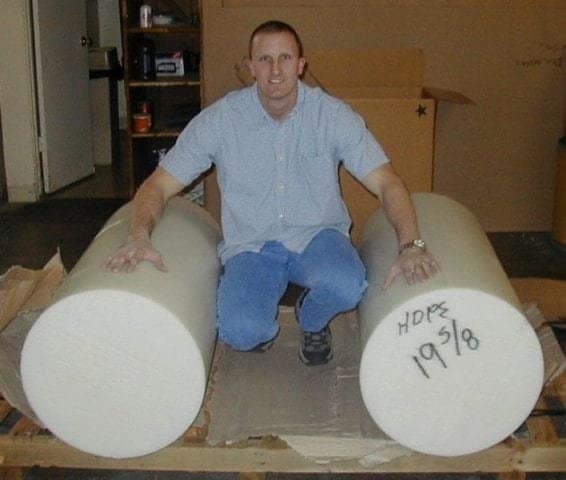
Polyethylene
HDPE & LDPE
(High Density and Low Density Polyethylene)
Both materials are in the Polyolefin family of plastics, along with Polypropylene (PolyPro) and UHMW (Ultra High Molecular Weight). Manufactured by a variety of manufacturers under the names: Polyboard®, Polymar®, Hostalen®, Polystone®, Hitec®, Sanatec®, Sanalite®, Ultra Ethylux®, Polycarve®, and Densetec®.
For great abrasion resistance, very low density and FDA/NSF compliance, Polyethylene is an excellent choice.
Occasionally we are asked for the difference between Acetal and HDPE – here is an explanation.
Still not sure HDPE/LDPE Polyethylene is the proper material for your application, consult our free Plastic Materials Selection Guide.
Click On Tabs For More Data

-
Why use HDPE/LDPE in your applications:
Using our HDPE sheet as a cutting board? Read more about HDPE Cutting Boards here.
This materials is…exhibit high impact strength, abrasion resistance and low coefficient of friction. Very light weight (density of .91 – .96) and extremely durable. FDA and NSF approved for food contact. Low forming temperature for ease of vacuum or thermo-forming.
- Self Lubricating and Low Co-Efficient of Friction
- Very High Chemical Resistance
- Low Specific Gravity (Floats in Water)
- Can be Heat Welded or RF Welded
- High Impact Strength and Energy Absorption
- Excellent Wear Resistance and FDA/NSF Approved
- Exceptional Low Temperature – Brittle at -110ºF
Still not sure HDPE/LDPE Polyetheylene is the proper material for your application, consult our free Plastic Materials Selection Guide.
-
Applications – Frequently used in:
- Cutting Board and Food Preparation Surfaces
- FDA, USDA, NSF Compliant Machined Parts
- Heat Formed and Vacuum Formed Parts
- Dasher Board For Ice Rinks – Impact Parts
- Welded Tanks, Hoppers, Silo Linings and Slide Chutes
- Chemical and Structural Tanks and Covers
- Food Processing Equipment, Valve and Pump Components
Still not sure HDPE/LDPE Polyetheylene is the proper material for your application, consult our free Plastic Materials Selection Guide.

These Properties are for evaluation purposes only. This information is not to be construed as a warranty, guarantee or assurance that you may achieve the same results. Materials made from different resin types, manufacturing techniques and manufacturers will react differently. The information should be used to compare against other materials only, and each user should make his own tests to determine suitability. No warranty as to this materials suitability are either expressed or implied.
-
Materials Available As:
Extruded Sheet:
.030 – 2.0″ in 48″ X 96″ Smooth Surfaces Natural Sheet in HDPE, 1″ max. for LDPE
Black available in many sizes of HDPE
Film:
.015″ – .060″ in 48″ wide Natural
Rod:
.250″ – 10″ diameter in Natural HDPE – 96″ lengths
From 12″ and up to 30″ diameter in 48″ lengths or 39″ lengths in HDPE
Black is available in many sizes of HDPE
Tube:
.250″ OD – 10″ OD in various wall thicknesses. Most available in HDPE and many in LDPE
Special Formulations:
Conductive, Static Dissipative, Custom sizes, Formulations, Profiles or Colors.
These Properties are for evaluation purposes only. This information is not to be construed as a warranty, guarantee or assurance that you may achieve the same results. Materials made from different resin types, manufacturing techniques and manufacturers will react differently. The information should be used to compare against other materials only, and each user should make his own tests to determine suitability. No warranty as to this materials suitability are either expressed or implied.
-
HDPE/LDPE Sheet and HDPE Rod are a common plastic ‘building block’, used in numerous applications. From model making to FDA compliant parts. In stock and ready to ship, cut to size or we can provide ‘blanks’ to ease your production.
Typical Resin Properties:
| General Property |
ASTM
Test |
Typical Value HDPE |
Typical Value LDPE |
| Specific Gravity |
D792 |
.941 – .965
|
.91 – .925 |
| Tensile Strength Yield |
D638 |
3,800 – 5,500
|
1,400 – 2,000 |
| Izod Impact – Notched |
D256 |
2.0 – 3.5
|
>16
|
| Vicat Softening Temp |
D1525 |
257ºF |
219ºF |
| Hardness – Rockwell |
D785 |
D60 -70
|
D42 – 50
|
Continuous Use Temp
|
– |
-100 – 180ºF
|
174ºF |
| Deflection Temp @ 66 psi |
D648 |
171 |
124 |
| Co. Thermal Expansion |
D696 |
7X10⁻⁵ |
4.6 -5.5X10⁻⁵ |
These Properties are for evaluation purposes only. This information is not to be construed as a warranty, guarantee or assurance that you may achieve the same results. Materials made from different resin types, manufacturing techniques and manufacturers will react differently. The information should be used to compare against other materials only, and each user should make his own tests to determine suitability. No warranty as to this materials suitability are either expressed or implied
-
“Thank you for suggesting Polyethylene plastics for our cutting surface. Works great. Took home a few of our remnants, and my wife loves them for cutting in the kitchen” – Eddie T.
“We have been using your LDPE for our metal bending press, and it works great. This prevents the press from scratching or denting the metal as we been it. Thanks for the help” – Robert P.
Here is the Pricing Page.
Click on ‘Sheet’ or ‘Rod’ for Pricing.

These Properties are for evaluation purposes only. This information is not to be construed as a warranty, guarantee or assurance that you may achieve the same results. Materials made from different resin types, manufacturing techniques and manufacturers will react differently. The information should be used to compare against other materials only, and each user should make his own tests to determine suitability. No warranty as to this materials suitability are either expressed or implied.
Google+
Print, Email or Share this:
We are looking to get some HDPE stock, 20 inch diameter x 42 inch length or half of those two dimensions for a machined prototype for our senior projects class. If you could send me a quote on those two pieces, and have any recommendations of other plastic polymers that would be good to machine and make a displayable model of our design. We are looking to keep it low cost as possible and will be only for visual aid as long as the material can be machined easily and consistently.
Stefan, We can certainly supply 20″ diameter rod. However, you mention that you are looking for a low cost option. Any plastic material that is 20″ in diameter is not a low cost option, HDPE is one of the least expensive materials, and in 20″ diameter the price is currently about $1,200.00 per foot. All very large diameter plastic rod is going to be in this price range, as it may take several days just to make one length (it is a very slow process).
Can you tell us what you are working on, and the minimum dimensions, perhaps we can find a different way to make it.
Thanks for your interest.
Hayden
[...] of our lower cost materials: HDPE, PVC, Styrene – less expensive, not cheap. Each with very specific strong points, and yes weak [...]
[...] Polyethylene (HDPE & LDPE) [...]
[...] in your local city, look at the brightly colored panels used to make the play equipment. This is a HDPE sheet with heavy UV additives, and this makes an excellent application. Available in a rainbow of colors [...]
[...] of Nylon when they are looking for an FDA approved plastic? Or, do they consider Acetal, Delrin, Polyethylene, and other materials first? Do you think of Nylon rod, bar, sheet and slab as mechanical materials [...]
[...] Polyethylene (HDPE & LDPE) [...]
[...] Polyethylene (HDPE & LDPE) [...]
[...] Polyethylene (HDPE & LDPE) [...]
[...] Polyethylene (HDPE & LDPE) [...]
[...] Polyethylene (HDPE & LDPE) [...]
[...] plastic we carry that are available as a recycled product are Reprocessed UHMW Sheets and Rods and Repro HDPE. The HDPE is available as post consumer content from milk jugs and laundry soap [...]
[...] Polyethylene (HDPE & LDPE) [...]
[...] plastic with the number 2 symbol on it is HDPE which is a plastic primarily used for grocery bags, milk jugs and laundry detergent [...]
Hi, I’m looking for two solid blocks about 3″x6″x~8″ in the cheapest rigid plastic possible. I will be machining them and then welding them together to make a first-cut prototype. Durability etc. is not a concern at this point as long as they can be welded together with epoxy etc. and are not water soluable.
Would it make more sense to laminate 6 – 1″ thick sheets, cut them to size and then machine in this circumstance?
Thanks,
Greg
Hi Greg, we would recommend using two 3″ pieces of ABS or PVC instead gluing six 1″ pieces. A factor you have to take into consideration is whether or not the glue will dry evenly on the multiple pieces. Simply put, it is much easier for the glue to bond evenly on two pieces instead of six–which will result in an easier product to machine.
[...] time you are cutting vegetables on your cutting board, the material most likely to be used is Polyethylene. Because it is stain, moisture and odor resistant, Polyethylene is a perfect choice. Other cutting [...]
[...] a plastic material, High Density Polyethylene (HDPE) that has been filled with the natural mineral boron. This boron filled (typically a 5% boron fill) is used to shield neutrons [...]
[...] HDPE Rod [...]
[...] LDPE and HDPE Polyethylene Sheets – Live Chat Also Available [...]